
This week it was the judging of Keswick Photographic Society’s first Open Competition. This event is always well attended and particularly so when we are to be entertained as well as having our photographs critiqued by our favourite judge. A member of the newly emerged Dalston Photographic Society, from the ashes of Morton Photographic Society, Richard Speirs DPAGB APAGB BPE2 is a photographic judge with local, national and international experience. He is invited every year to judge one of our competitions because he is so well respected. Equally, he enjoys the very high standard of our submissions, so takes little persuading to accept our invitation.
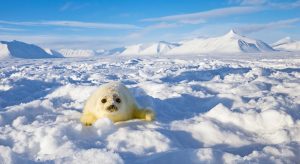
It was a busy night for Richard in that there was once again a very high quality set of prints and Projected Digital Images (PDIs). He began with the prints where, of the 38 entries, seven of them gained the maximum score of 20 points. The very first print to be judged was a Bearded Seal pup in its cold and desolate environment. It painted a bleak picture for this pup, the image of which was captured by Simon Roberts;
Alan Walker was next with a realistic 1950s style image of a young lady before a background of washing on a line entitled Wash Day, judged best creative image;

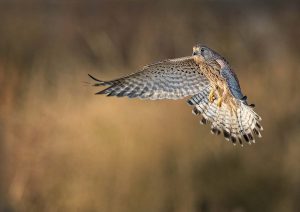
Pete Whieldon caught in fine detail a flying Kestrel in evening light, its wings in the perfect position for maximum photogenic quality;
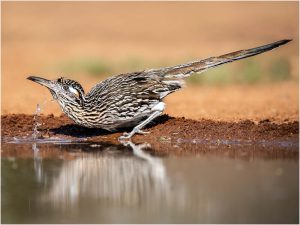
Ronnie Gilbert with one of his famous wildlife images, this time of a perfectly framed Thirsty Roadrunner (over all Best Print of the competition);
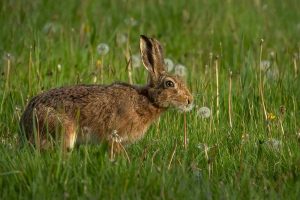
Carol Minx with a beautiful portrait of a hare eating a dandelion clock (best Nature);
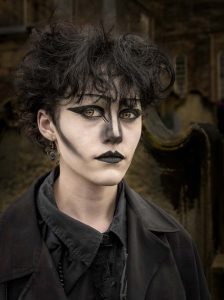
David Price with a perfectly positioned portrait of a well decorated female Goth at Whitby also judged best people image;
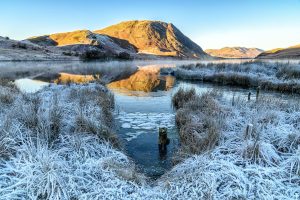
and a landscape by Fred Bell capturing a wintry scene looking towards Melbreak (Best Landscape).
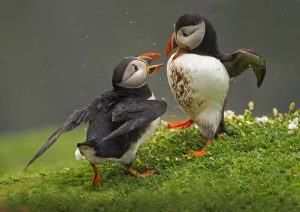
After the tea and Marilyn’s home baked cake, Richard assessed and scored the 58 PDIs. Once again there were seven images scoring the maximum 20 points. Pete Whieldon scored his second of the night with a pin sharp image of a pair of courting Puffins;
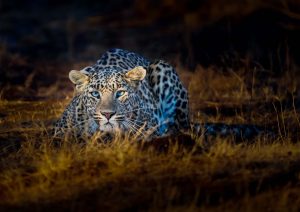
Simon Roberts gained his second maximum score with an image called ‘Cat’s Eyes’. It was a Jaguar, apparently poised to strike and definitely too close to the camera for comfort!
Bob Given also managed two maximums with sporting images, the first a High Tackle between to powerful female rugby players:

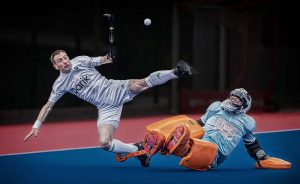
and the second, a ferocious tackle in a men’s Hockey match between Goalie and an unfortunate attacker. The image was titled, ‘Taken Out!’ and was judged the best PDI.
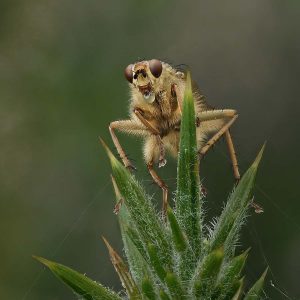
Jo Knight scored a maximum with a fine macro shot of a Dung Fly. She had overcome the difficulty of a short depth of field in such photography and the insect was pin sharp throughout.
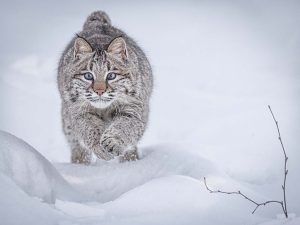
Alan Walker’s second 20 was of a Bobcat chasing prey under the snow. Running towards the camera, Alan captured the intensity in fine detail of this beautiful animal.
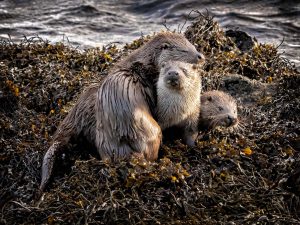
Julie Walker was not to be outdone in the wildlife selection and produced a wonderful picture of a wild Otter family intertwined, from her visit to the Shetlands.
All the entered images can be viewed on our gallery pages: 2023-2024 Competitions


