
Tom Peck spoke to us via zoom from his home on the history and development of Documentary Photography along with the related themes of War Photography, Street Photography and the Depiction of Englishness. He began by outlining the historical development of the subject, with reference to the iconic 1936 image of Florence Owens Thompson by Dorothea Lange. The title of the photograph is Migrant Mother and is often referred to as the “Mona Lisa of the 1930s.”
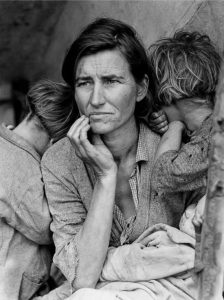
Documentary Photography developed to chronicle scenes or events that had a historical significance or simply record scenes of everyday life. The photographs were designed to tell a story and used to reinforce a particular journalistic viewpoint but were often also used for propaganda purposes.
Tom referred to the work of Lewis Hine and how the appeal of his photographs stemmed not just from the subject matter, but also their aesthetic beauty. During the early part of the 20th Century, Hine would bring public attention to controversial subjects by disguising himself and clandestinely photographing important social issues such as child labour hardships. His photographs were about telling the observer what was happening in the world, and he would use Documentary Photography to tell facts whilst being the opposite of art.
Following the invention of photography in 1839, one of the very earliest examples of Documentary Photography was the 1848 image of the View of the Great Chartist Meeting on Kennington Common by William Edward Kilburn. The photograph provided proof that the government of the time was lying when it denied that a meeting to deliver a petition by labour reformists had occurred. Tom then went on to describe how photographs don’t necessarily tell the whole story with the example of Roger Fenton’s Valley of the Shadow of Death from 1855. The location of the photograph was where the Charge of the Light Brigade had happened a year earlier (1854), but the battlefield had become a sanitised version of its former self and Fenton was reputed to have arranged multiple cannon balls in the scene to give the picture more impact. Tom later described a more recent example of War Photography using Joe Rosenthal’s 1945 Pulitzer Prize winning Old Glory Goes Up on Mt Suribachi, Iwo Jima that was controversially restaged and shot the day after the end of the battle.
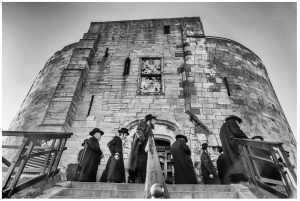
Tom would intersperse the historical theme with his own images such as the Massacre of the Jews, York. 1190, which commemorated an event that occurred during the reign of King Richard 1st. He then revealed that the present-day daffodils planted beneath York Castle were a representation of the Star of David because of their 6 yellow petals.
The presentation then deviated towards Street Photography, which is a more candid genre that features random poetical events in a public space. An early example was J H Lartigue’s metaphorical 1911 image of Avenue du Bois de Boulogne Paris where a horse and carriage were seen disappearing out of the scene of a stylish dogwalker, whilst featuring the arrival of a modern motor car.
Overall, the members of Keswick Photographic Society were treated to a historical tour de force by Tom Peck and everyone came away feeling they had been educated and entertained at the same time.
Clive Penkett